
Tree Pollarding Bromley
Professional tree pollarding in Bromley and surrounding areas. Our trained arborists assess each tree’s suitability and carry out careful pollarding to manage its size and growth.
Professional tree pollarding in Bromley and surrounding areas. Our trained arborists assess each tree’s suitability and carry out careful pollarding to manage its size and growth.
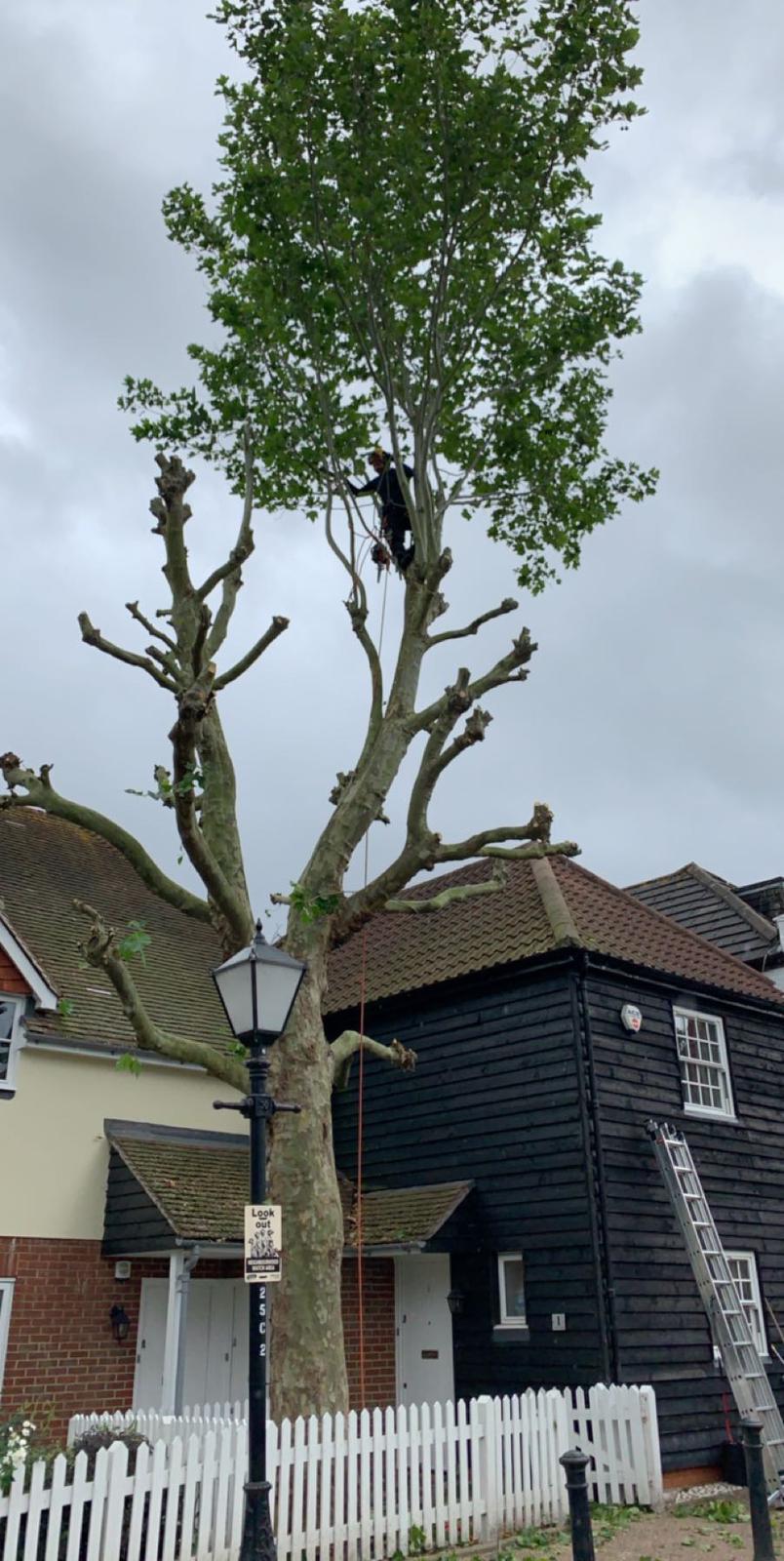
Large tree species in urban areas were often planted for their pollution tolerance and ability to withstand harsh city conditions. Many of these trees were pollarded, a traditional tree pruning method, where the head of the main branches is cut back to encourage bushier foliage growth. Tree pollarding in Bromley is carried out to:
Prevent trees from outgrowing their allotted space
Reduce excessive shading over streets, properties, and gardens
Avoid obstruction of electric wires, streetlights, and gutters
Make urban tree maintenance and management more practical
With modern improvements in air quality, a wider range of smaller, lower-maintenance tree species can now be planted. However, pollarding trees in Bromley remains appropriate in certain situations, such as along main roads where large trees are needed to provide a tall, clear stem for visibility and clearance.
How Pollards Develop
Pollarded trees are identified by the numerous branches originating from the same point on the tree. These shoots develop from:
Dormant buds located beneath the bark
Adventitious growth from wound tissue
Initially, these new branches are weakly held as they grow from under the bark. Over time, as the tree lays down annual growth rings, the union strengthens, often forming a thickened base at the junction of shoot and trunk. Over several years, a noticeably swollen pollard head or boll develops where new shoots emerge each year. Regular maintenance involves removing shoots while the wood is still young and close to the base of the new growth.
Tree Species Tolerant of Pollarding in Bromley
Some tree species particularly suitable for tree pollarding Bromley include:
London plane (Platanus x hispanica)
Common lime (Tilia x europaea)
Other responsive species include:
Acer (Maple)
Alnus (Alder)
Fraxinus (Ash)
Liriodendron (Tulip tree)
Morus (Mulberry)
Quercus (Oak)
Ulmus (Elm)
Tree pollarding services in Bromley help extend the life of urban trees, maintain their health, and ensure they fit within their designed space while remaining safe, visually appealing, and easy to manage. With professional tree pollarding Bromley, your trees will thrive while enhancing the beauty and safety of your landscape.
Tree pollarding in Bromley is a traditional pruning method that promotes healthy regrowth while controlling structural problems and overgrowth in urban areas. When done correctly, pollarding enhances tree safety, longevity, and overall appearance.
Timing Considerations for Pollarding
The optimal time for most tree species is late winter or early spring, when food reserves are high and water stress is low. Key points include:
Avoid pruning Acer (Maple) in spring to prevent excessive sap bleeding.
Summer pollarding is possible after food reserves are replenished, but avoid drought periods.
Summer pruning can expose pollard heads and roots to sunlight, which may reduce growth.
Autumn pruning is less ideal, as drier wood is more susceptible to decay fungi, especially in frosty conditions.
Pollarding Young Trees
Starting with young trees is recommended:
Allow the tree to reach the desired height and branch structure before the first pollard cut.
Establish a regular pruning cycle to maintain tree form and structural integrity.
Maintaining a Pollard Tree
Ongoing care is crucial for safety and health:
Crowded or angled new branches can cause weakness if not managed.
Regular pollarding reduces the need for major future surgery on older branches.
Always cut above previous pollard points to avoid exposing older wood prone to decay.
In some cases, leave a few living branches or cut above a side branch depending on species.
Professional Advice is Key
Each tree species reacts differently to pollarding. Consulting a qualified arboriculturist ensures safe and effective tree pollarding in Bromley, tailored to your trees’ growth patterns and structure.
Properly timed and maintained pollarding protects property, enhances tree health, and ensures attractive, long-lasting growth for both young and mature urban trees.

Neglected pollards could lead to large trees that can cause a nuisance. It may be desirable to bring trees back into regular pruning to restrict their size. It is best to consult an arboriculturist about what to do with a lapsed pollard tree. In some cases a tree can be cut back to the original pollard head. Platanus x hispanica (London plane) responds to this treatment, as it is less prone to decay when older wood is exposed.
When trees such as Aesculus x hippocastanum (horse chestnut) which are prone to decay need to be brought back into pollard management they may be cut to a point higher in the tree to avoid exposing large amounts of older wood, creating a second set of pollard heads. In some cases, such as Carpinus betulus (hornbeam) or Fraxinus excelsior (ash) it is beneficial to retain some of the branches to maintain channels of active wood. Some oak trees such as Quercus robur and Quercus petraea do best with substantial portions of their main branches retained.
Another option suited to some trees is to carry out crown reduction and thinning to reduce the weight of the crown instead of returning to a cycle of pollarding. The tree can then be monitored for any further maintenance as it is required.
Trees with weaker wood prone to producing multiple shoots, such as Populus (poplar) and Salix (willow) can become hazardous and should be returned to a frequent cutting cycle. Trees such as Fagus sylvatica (beech), Quercus robur (oak) and Castanea sativa (sweet chestnut) are a problem mainly where branches become heavy when the pollard has lapsed for many decades.


© 2026 Kent Tree Care.